
Menu
Joab, the son of Zeruiah
By Mark Morgan | David
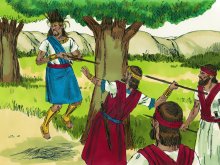
Joab, King David’s nephew and army commander, is an enigmatic figure in the Bible. He has always fascinated me.
When Bible characters fascinate me, I want to write novels about their lives. Why? To make them more real to me! And while doing so, my perfectionist tendencies force me to find out everything I can from the Bible to avoid any glaring errors. The resulting extensive research is very helpful for me.
In November 2024 I began a speed-writing exercise, trying to write 50,000 words about the life of Joab. That attempt failed badly, but I tried again in November 2025 and that time I was successful, leaving me with a half-written story about Joab that I am still working to complete.
Joab is a controversial character. We know, at one and the same time, both a lot and very little about him. He plays a supporting part in many of the events of David’s life, but there is little reporting of the motivation that drives his actions. As a result, the assessment of his motives in individual incidents often depends more on a reader’s pre-conceived idea of the man than any attempt at impartial assessment.
Since David is described as a man after God’s own heart,[1] and is presented as being in conflict with Joab during various defining events in David’s life, Joab is often dismissed as a godless, cruel and vindictive man.
This seems a very shallow assessment – after all, David kept Joab as the commander of his army for about 40 years, which feels completely unbelievable had David’s opinion of him been completely negative.
When one also takes into account David’s fulsome comments about King Saul (2 Samuel 1:19-24), Abner (2 Samuel 3:33-39; 1 Kings 2:32), Absalom (2 Samuel 18:5, 33; 19:1-4) and Amasa (1 Kings 2:32) – despite the fact that each of these men was willing to fight against God’s anointed whenever it suited them – one has to wonder about David’s uncritical praise of such people.
One also has to wonder just how close to the mark Joab’s assessment of David was when he said, “you love those who hate you and hate those who love you” (2 Samuel 19:6). True, it might have been exaggerating a little, but we do have more examples of David praising or excusing his sworn enemies (Saul, Abner, Absalom, Amasa, Ish-bosheth, Shimei and possibly Ziba) than his friends (Jonathan and Ittai). Criticism of his friends is more common in the records we have (Joab, Abishai and possibly Mephibosheth).
David was often generous with enemies, but could be harsh with loyal helpers and friends when they opposed him.
Not only so, but the vengeful attitude shown by David towards Shimei at the end of his life (1 Kings 2:8-9) – despite having earlier forgiven him (2 Samuel 16:5-14; 19:16-23) – is in stark contrast to the generous nature David had shown in so many earlier situations throughout his life. Perhaps his actions and statements at the end of his life should be assessed with the same generosity as he had shown earlier. His body was failing and perhaps his mind was also.
As with all of us, David was not a fixed character from the start to the end of his life. He lived and grew and even failed at times. What is very clear is that after David’s death, God esteemed him more highly than any other king of Israel or Judah. David really was a hero of faith.
So what about Joab? What do we really know about him?
King David was the youngest son in his family,[2] and we know of two sisters as well: Zeruiah and Abigail.[3] Zeruiah may have been the elder, since she is listed first and Abigail is elsewhere described as ‘the sister of Zeruiah’.[4]
Since Zeruiah’s sons were already important leaders in David’s army very early in his reign – when he was about 30 years old – it is likely that they were not much younger than David. They may even have been older.[5] Either way, it is likely that Zeruiah was significantly older than David.
All that we know about Zeruiah’s husband is that he was already dead when, shortly after Saul’s death, Asahel was killed in battle and subsequently buried in his father’s tomb in Bethlehem.[6]
The birth order of Zeruiah’s three sons is not specified, but the order given in 1 Chronicles 2:16 is Abishai, Joab and Asahel.[7] They are also listed together in 2 Samuel 2:18 with Joab first, followed by Abishai and Asahel. By this time, however, Joab was the leader of David’s army, so national importance may have caused him to be placed first in the list rather than age.
When writing a story that spans more than 40 years of a character’s life, it is easier – and feels more authentic – to choose relative ages for the main characters that fit the information we have and work from there. On this basis, I have guessed that Zeruiah was about 15 years older than David and assumed that 1 Chronicles 2:16 has given us the birth order of her sons, with Abishai, the oldest, being five years younger than David, Joab seven years younger and Asahel, the youngest, nine years younger than David.[8]
None of Zeruiah’s three sons is mentioned in relation to Saul’s army, and Abishai is the only one linked with David’s men before the death of Saul. David asked Abishai to go with him into Saul’s camp[9] while Saul was hunting them in the wilderness, and together they crept into Saul’s camp at night, took his spear and the jar of water standing near his head and left. In that episode, Abishai is described as the brother of Joab, suggesting that when the record was written, Joab was better known than Abishai; yet both Abishai and Asahel are listed with David’s mighty men[10] while Joab is not.
It’s also worth noting that Asahel was killed not long after Saul’s death, so if he was already a “mighty man” by that time, he must have been involved in warfare during Saul’s reign.[11]
When David became king over Israel a few years later and wanted Jebus/Jerusalem as his capital, Joab won leadership over the national army by defeating the Jebusites.[12] This is the only act of individual bravery attributed to Joab, yet even that probably depended on effective leadership. Joab is generally presented as an army commander rather than as a individual soldier, although he did kill Abner (with Abishai’s cooperation), Amasa and Absalom (with his bodyguard’s help).
Due to their position, family connections, bravery and success, all of Zeruiah’s sons were probably closely associated with David’s mighty men, including Uriah the Hittite (Bathsheba’s husband) and Eliam (probably Bathsheba’s father[13] and son of Ahithophel of Giloh[14]). Joab’s armour-bearer, Naharai of Beeroth, was also a mighty man.[15]
These close ties probably caused great conflict within this elite group of fighters when David committed adultery with Bathsheba while the army was away at war, then secretly arranged Uriah’s death and married his widow. It is hard to underestimate the terrible effects of this uncharacteristic disloyalty on David’s subsequent reign. Yet Joab stuck with David and did his best to get him back on track.
Joab was an astute, faithful and successful leader in his own right, and clearly loved his uncle David deeply.
Bible Tales article: King David’s Family Tree
Bible Tales article: Harmony of Bible records of David’s life
Joab (Wikipedia)
King David (Wikipedia)
Notes
| ↑1 | 1 Samuel 13:14 |
|---|---|
| ↑2 | 1 Chronicles 2:13-15 |
| ↑3 | 1 Chronicles 2:16 |
| ↑4 | 2 Samuel 17:25 |
| ↑5 | Joab’s apparent good health at the end of David’s life may argue against this possibility. |
| ↑6 | 2 Samuel 2:32 |
| ↑7 | Where we can tell, 1 Chronicles 2 mostly lists children in birth order (although the sons of Jacob are not completely in order). |
| ↑8 | Since Asahel died when David was about 30-32 years old, if he was 9 years younger than David, he would have been 21-23 years old. We know that he had a son (Zebadiah, see 1 Chronicles 27:7), which is quite reasonable at that age, but he could not be much younger. |
| ↑9 | In 1 Samuel 26:5-12, David also asked Ahimelech the Hittite, but only Abishai is specifically mentioned as going with David. |
| ↑10 | 2 Samuel 23:18, 24; 1 Chronicles 11:20, 26; see also 2 Samuel 21:17 and 1 Chronicles 18:12 |
| ↑11 | We are not told what Asahel did to qualify as a “mighty man”. |
| ↑12 | 1 Chronicles 11:6 |
| ↑13 | 2 Samuel 11:3 |
| ↑14 | Ahithophel was David’s counsellor – 2 Samuel 15:12 |
| ↑15 | 2 Samuel 23:37; 1 Chronicles 11:39 |