
Menu
Assyria
By Mark Morgan | Miscellaneous
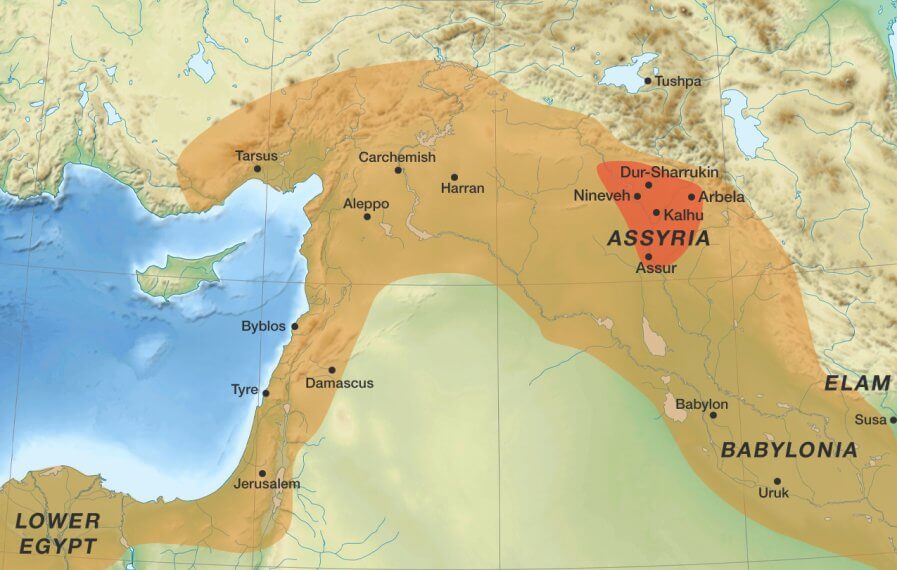
Assyria is one of several powerful nations in the Old Testament that often threatened Abraham’s descendants, the Jews. However, our first introduction to Assyria comes well before Abraham. In Genesis chapter 2 we are told of four rivers that had their source in the Garden of Eden. Of these, the Tigris (also called Hiddekel) flows through Assyria. Assyria was known as Assur, Asshur or Ashur, a name also given to a city and a god. The Tigris River flows just to the east of the city of Assur – as described in Genesis.
Asshur, after whom these places (and the god!) were named, was a son of Shem, the son of Noah,[1] although one of the early rulers in the area was Nimrod,[2] a son of Cush, the son of Ham.[3]
Jonah, an Israeli prophet famous for being swallowed by a huge fish and surviving three days and three nights inside it, had been instructed by God to go to Nineveh, the capital of Assyria at the time. He was to deliver a message of coming destruction, but tried to run away instead. His reasoning was that the Assyrians would immediately repent and that God would forgive them and delay the destruction. What was the problem with this, you may ask? Assyria was known as a brutal nation and in Jonah’s day their strength was growing quickly. Jonah was convinced that they would attack Israel and demonstrate their cruelty, so he wanted the nation destroyed.
Having run away and caught a ship travelling in the opposite direction from Assyria, Jonah hoped to avoid God’s requirements, but it didn’t work. A terrible storm almost sank the ship and Jonah suggested that the sailors should throw him overboard, which they reluctantly did. The storm immediately stopped and Jonah was swallowed by a huge fish, inside which he finally began to pray and acknowledge God’s kindness. After three days and three nights[4] the fish vomited him onto dry land and he began to make his way to Nineveh. Jonah’s concern that the Assyrians would repent was proved completely correct. Their king led them in abject repentance and God duly forgave them. Jonah was not at all pleased with this and complained to God, who responded by describing his care for ignorant people who would repent if only they could learn of God.
We don’t know exactly when Jonah prophesied because the king of Assyria is not named, but it was probably in about 775-750BC, while the Assyrian army attacked Israel and destroyed the northern kingdom in 722BC, only 25-50 years later. Their repentance didn’t last very long, and Jonah’s worst fears were quickly realised.
I mentioned earlier that the Assyrians were cruel, but what evidence is there? Were they really cruel, or did they just get bad publicity? The fact is, they were the ones who advertised their cruelty. They used it as a psychological weapon, the most powerful in their arsenal, to overcome resistance and extend their empire. Everyone knew about their cruelty because they made sure everyone knew about it. Not only so, but they carved detailed pictures of their brutality on the walls of their imperial palaces.
When the Assyrians attacked a nation, the knowledge of their cruelty had gone ahead of them, weakening their victims’ resolve and making them more likely to give up than to fight. Fear was their most powerful weapon.
When Assyria defeated a nation, their policy was to transport the people to other conquered lands. Maintaining external control over a nation that remains in its own land has always been difficult: the local population is more familiar with the terrain, climate, defences and hidden resources, as well as having a strong connection to the land of their fathers. Once a people is taken away and dumped in another land they are severely weakened, unfamiliar with their surroundings and no longer motivated to defend their homeland.
After a few years, the drive to return to their homeland weakens, and after a few generations it disappears completely because the new location has become home. This is demonstrated by the Samaritans whom the Assyrians had transplanted from other nations into the north of Israel: but they soon considered Samaria their homeland and were still living there in the time of Jesus, following some of their old customs but also having adopted many of the customs of the Israelis.
It is important to note that the Jews are an exception to this basic rule. Despite Israel being taken into captivity to Assyria and Judah later being taken away to Babylon for 70 years, the nation returned in the time of Ezra and Nehemiah to rebuild their state in Israel. Five centuries later, they were banned from living in the land of Israel by the Romans and spread around the world, but almost 2,000 years later in 1948, they returned to re-form a state in their homeland, once more called Israel. Of course, these were special cases, because Israel is God’s people and God had predicted their return each time. No other nation has done such a thing.
The Assyrians believed this process of transportation would weaken the resistance from subjugated peoples and strengthen their empire. However, it doesn’t seem to have been any more effective in making their empire last than any other methods people have tried. In the end, all human empires decline and fall.
The Bible includes information about the Assyrians incidentally. For example, the names of some Assyrian kings and positions in their army are mentioned because of their attacks on Israel and Judah.
|
King |
Accepted Dates |
Bible references |
|---|---|---|
|
Tiglath-pileser/Tilgath-pilneser (III) (also called Pul in 2 Kings 15:19 and 1 Chronicles 5:26) |
745-727 BC |
2 Kings 15:19, 29; 16:7, 10; 1 Chronicles 5:6, 26; 2 Chronicles 28:20 |
|
Shalmaneser (V) |
727-722 BC |
2 Kings 17:3; 18:9 |
|
Sargon (II) |
722-705 BC |
Isaiah 20:1 |
|
Sennacherib |
705-681 BC |
2 Kings 18:13; 19:16, 20, 36; 2 Chronicles 32:1, 2, 9, 10, 22; Isaiah 36:1; 37:17, 21, 37 |
|
Esarhaddon |
681-669 BC |
2 Kings 19:37; Ezra 4:2; Isaiah 37:38 |
The Tartan is mentioned in 2 Kings 18:17 and is believed to refer to the second in command in the Assyrian kingdom. The word means commander in chief or prime minister. See also Isaiah 20:1 where Sargon sent his commander in chief to take Ashdod. This is probably a translation of the Assyrian title.
Rabshakeh is the most common Assyrian title used in the Bible. “Rab” means chief, while “shakeh” relates to princes or cupbearers. The title is used in 2 Kings 18:17; 18:19; 18:26-28; 18:37; 19:4; 19:8; Isaiah 36:2; 36:4; 36:11-13; 36:22; 37:4 and 37:8. Interestingly, Nehemiah was cupbearer to the king of Persia a few hundred years later, but he describes his position using the Hebrew word for cupbearer.
Another Assyrian title “Rab-saris” is used in 2 Kings 18:17. Once again, “Rab” means chief, while “saris” means “eunuch”, “chamberlain” or “official”. Interestingly, the Chaldeans also used the title “Rab-saris” and it is included in Jeremiah 39:3 and 13. A variant is also used in Daniel 1:3 when King Nebuchadnezzar gave orders to the “chief of the eunuchs” (rab sarisav – “av” being a possessive suffix) to take young men (including Daniel and his three friends) from Israel to Babylon.
Notes